Library
The Levni Folio
1,628 drawn objects in 3,409 variants, one JSON file each. Scenes place them by name; style packs recolour them; anyone can add to them.
What the Folio is
A drawing (a prop) is a few SVG paths in a 0 to 100 box, with colour names instead of hex values. Names let a style pack or your own inks recolour every drawing at once. Drawings are grouped on fifteen shelves:
filmFilm & cinematvTV & broadcaststageStage & theatremusicMusic & audiobooksBooks, writing & schooltechTech & internetmoneyMoney & worklawLaw & politicssportSport & gameshomeHome & everydayfoodFood & drinknatureNature & animalsplacesPlaces & transporthealthHealth & bodysymbolsSigns, symbols & time
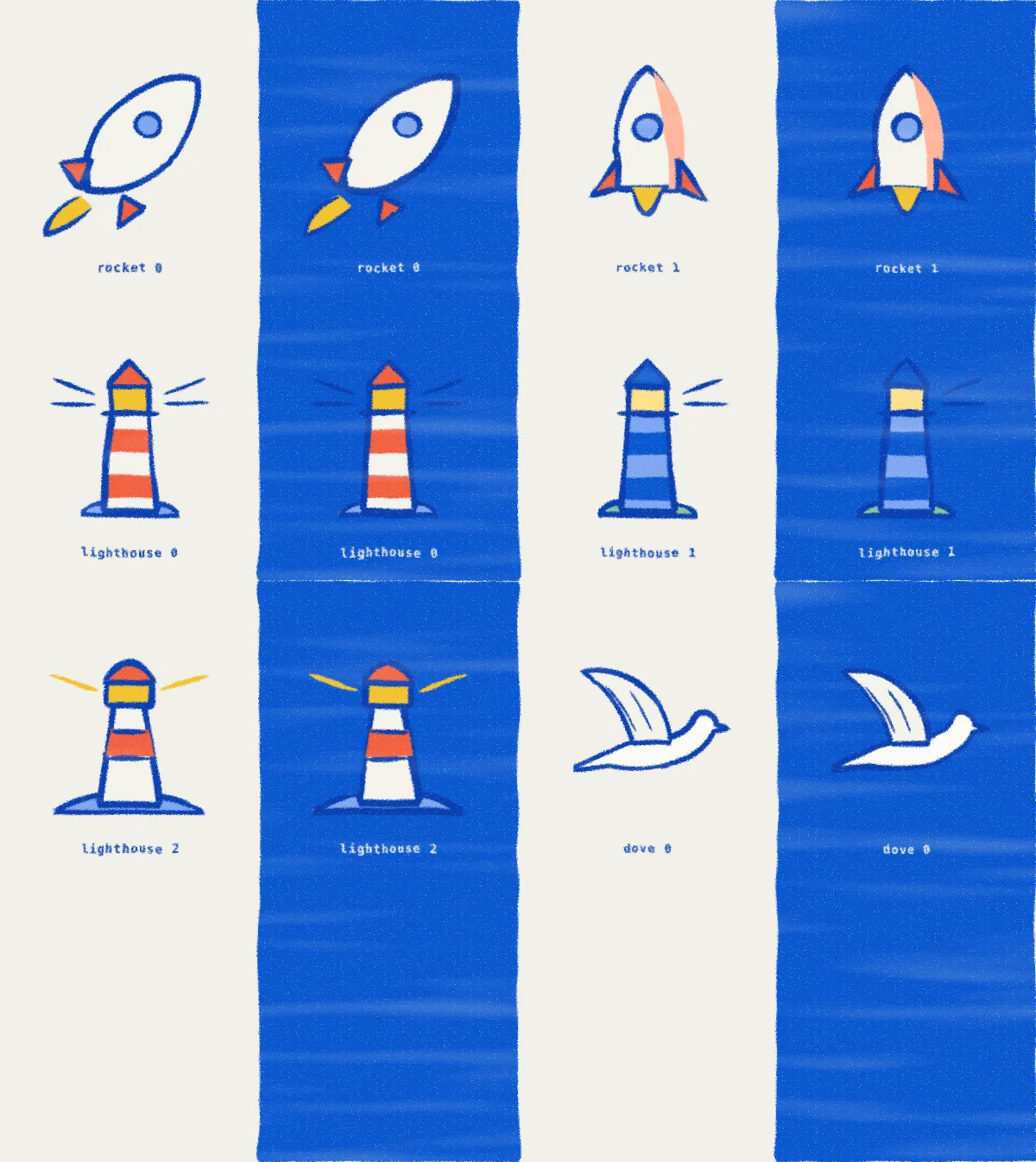
levni sheet look.png rocket lighthouse dove.Find a drawing
- On the web. Browse the library and search in English or Turkish (press / to jump to the search box). Each drawing opens with its tags, related drawings, copy-ready code for a scene, JavaScript or the CLI, an SVG download, and its own link:
/library/?p=lighthouse. - From the CLI.
npx @levni/levni list coffeelists names, variant counts and tags.npx @levni/levni sheet look.png coffee-cupshows them. - From an agent.
list_propstakes a query and an optional shelf and describes every variant in words;show_propsreturns a contact sheet image. See MCP tools. - From code.
findProp('telefon')matches names and tags in any language. See the Node API.
A name that is not in the library falls back to the icon element, which needs the optional @tabler/icons. Search first so you place real names.
Variants
A second angle or state of an object is another variant of the same drawing. Choose one with variant, counting from 0:
{ "type": "prop", "name": "lighthouse", "variant": 2, "x": 600, "y": 336, "size": 320 }If the number is too high, the last variant is used. The label under each drawing on a contact sheet (lighthouse 2) is the name and variant to write.
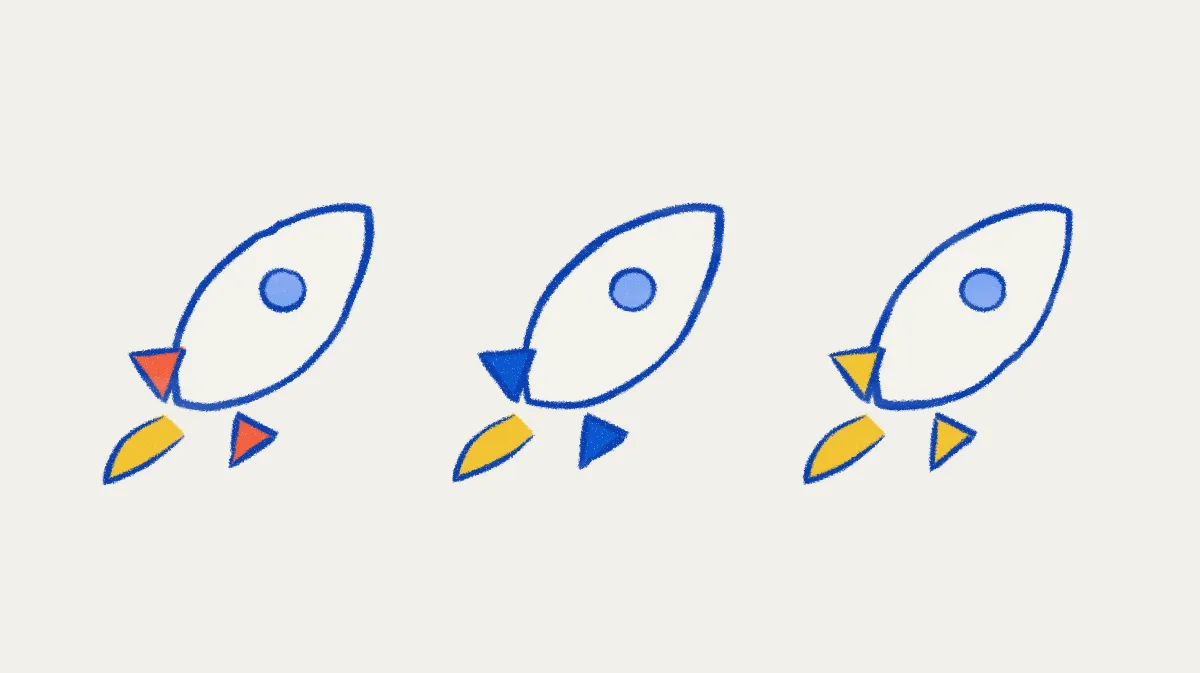
Recolour
Three levels, from small to large:
- One element.
"recolor": { "coral": "blue" }swaps house colours on that drawing."palette": "blue"folds every accent into the blue family, which the calm pack for sensitive stories uses. - The whole scene.
"style": "miniature"picks a style pack, or"style": { "blue": "#6A1B9A", "mustard": "#00BFA5" }gives your own inks for the house colour names. - A brand. A board or poster spec takes four
inksand re-inks everything it draws.
The house colour names are ink, blue, tone, coral, tone-coral, mustard, tone-mustard, green, tone-green, paper, white and dark.
recolor maps.Names, tags and notes
Names say what a drawing shows, not what it is used for, so they stay true in every story: floppy-disk, not save. Related drawings share the group word first (book-hardcover, book-stack), modifiers follow the thing they describe (heart-broken), and numbers appear only when the drawing shows them (dice-5, clock-hour-4).
- Renamed drawings keep working. An old name stays in the prop's
aliases, so a scene that saysarmchair-2still drawsarmchair-padded. - Tags are lowercase search words in English and Turkish, 4 to 8 per drawing, without repeating the name.
- Notes say what each variant shows in a short phrase (side view, spout to the right), so a model that cannot see images can still pick one.
- No brand names. The Folio draws no logos (why);
npm testrefuses names such asyoutube-play.
The full rule book, with the drawing rules and a checklist, is docs/folio-guide.md. Editors and agents can check a file against prop.schema.json.
Using drawings well
- Alt text. A drawing that carries meaning gets alt text saying what it shows in the story (“a cracked piggy bank next to a falling chart”), not “illustration”. A decorative one gets
alt="". - Not colour alone. If red against green carries the meaning, add a shape or a word too; style packs change colours.
- Contrast. On dark or busy backgrounds put the drawing on a paper panel or pick a pack whose ink stays visible.
- One drawing, one meaning on a page, and familiar objects over puns that do not travel between languages.
- Sensitive stories use
"palette": "blue"and the props taggedsensitive.
Licence and credit
The Folio is CC BY 4.0. Use it anywhere, commercially too, and credit it, for example “drawings by Ortak Alan (CC BY 4.0)”. The engine and code are MIT. Images you render are yours; the credit applies when they contain library drawings. Origins and flagged drawings are in NOTICE.md.
Submit a drawing
The Folio grows by contribution, and drawings are the most welcome kind. Each prop is one JSON file in library/props/:
{
  "name": "watering-can",
  "category": "home",
  "tags": ["garden", "water", "sulama"],
  "author": "Your Name",
  "variants": [
    { "note": "side view, spout to the right", "paths": [
      { "d": "M20 40 L70 40 L66 86 L24 86 Z", "fill": "tone", "stroke": "ink", "weight": 9 },
      { "d": "M70 52 L92 30", "stroke": "ink", "weight": 9 }
    ] }
  ]
}
Format
nameis the file name: lowercase English,a-z0-9and hyphens, named for what it shows (rules).tagsare lowercase, in English and Turkish.categoryis one of the shelf keys above.- Draw in a 0 to 100 box (y grows downward), centred, with the object filling 70 to 85 of it.
- Colours are names, never hex:
ink(outlines),blue,tone,coral,tone-coral,mustard,tone-mustard,green,tone-green,paper,white,dark. weightis the line width in output pixels: 8 to 10 for outlines, 4 to 6 for details.- A second angle or state of the same object is another variant, not another prop.
Check it
git clone https://github.com/Levni-Dev/levni.git && cd levni && npm install
npx @levni/levni add my-props.json --sheet check.png   # validates, writes to library/props/, draws them
npm test                                        # validates and renders the whole Folio
Open check.png: every variant on paper and on a blue panel. levni add also prints note lines for names, tags and notes that break the guide. levni check name measures a drawing in numbers, for agents that cannot see.
Review rules
- Own work only. Drawn by you. Drawing in the spirit of a style or tradition is welcome; tracing a specific work, photo, stock image or icon set is not. AI-assisted path code is accepted when you directed and checked it: say so in the pull request.
- No faces, no hands. People only as faceless pictograms.
- No logos or trademarks, and nothing that reads as one.
- One object, one idea. No text inside drawings, no scenes.
- House style. Simple shapes, two inks plus paper, readable at 120 px.
By submitting you release the drawing under CC BY 4.0 and are credited in its author field. Then open a pull request; automatic checks run on it. The full guide is CONTRIBUTING.md, and everyone taking part follows the Code of Conduct. Missing a drawing you cannot draw yourself? Ask for it.
Many drawings at once
You can have a chat model write several drawings in one go. docs/prop-prompt.md holds a prompt to copy. Paste the answer into a file and run levni add: it accepts a chat answer with ```json blocks, checks each drawing, skips the broken ones with a reason and draws the rest for you to look at.